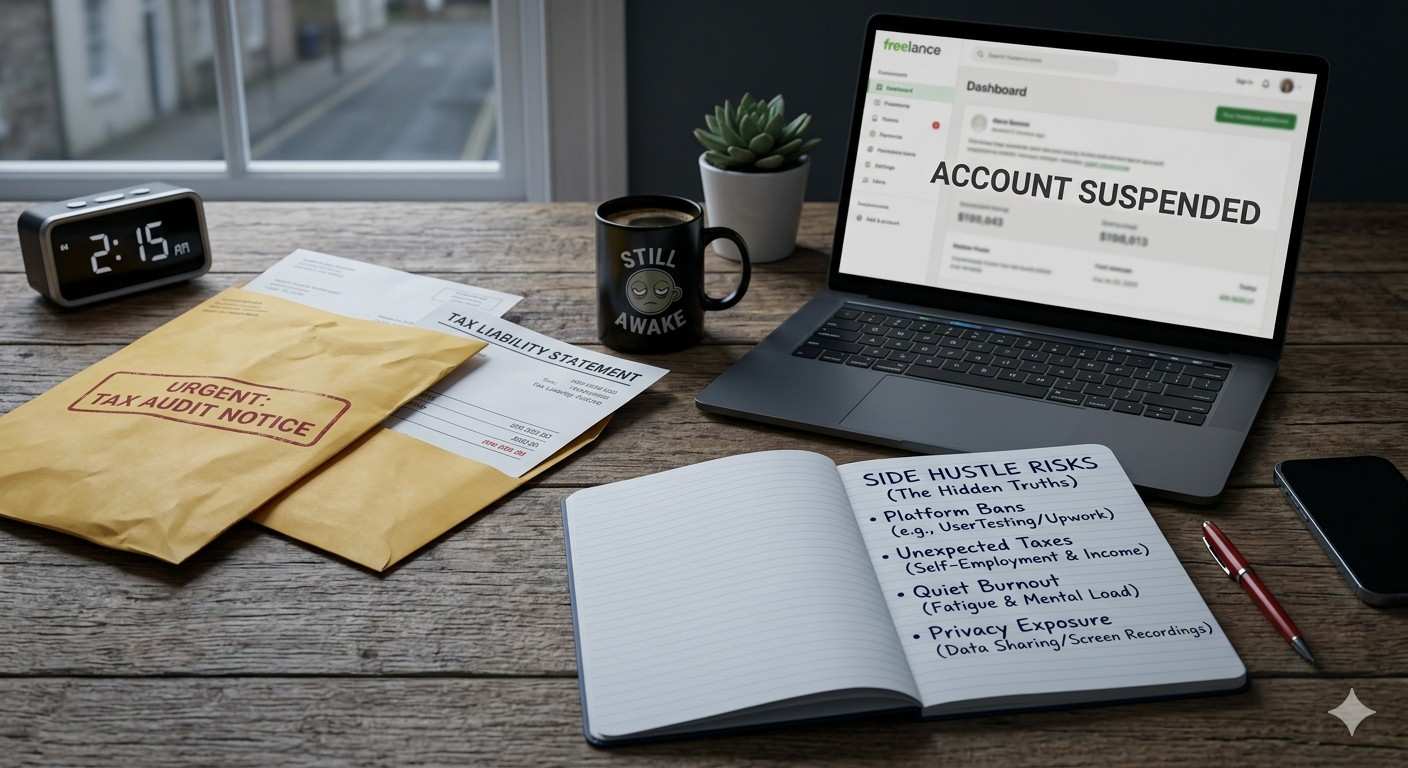
Side Hustle Risks Nobody Talks About Until It Is Too Late
Every side hustle article talks about how much money you can make. Almost none talk about what can go wrong.
Platforms can ban your account without warning and withhold your earnings. Tax bills can arrive that are far larger than expected. Burnout can creep up silently until you dread opening your laptop. And some side hustles expose personal information you never intended to share.
None of this should stop you from side hustling. But knowing about it ahead of time prevents painful surprises.
⚠️ Every side hustle has downsides. The goal is not to avoid them. It is to know about them so they do not blindside you.
Risk 1: Platform Accounts Can Disappear Overnight
This is the most common horror story in side hustle communities. Someone earns consistently on a platform for months. Then one morning they try to log in and their account is suspended. No warning. No explanation beyond a generic email. Their pending earnings are frozen.
Why This Happens
Platforms use automated fraud detection systems. These systems flag accounts for reasons that are sometimes legitimate and sometimes absurd. Logging in from a new device can trigger a flag. Completing tasks faster than the platform's algorithm expects can look like bot behavior. A single client dispute, even an unfair one, can freeze your entire account.
UserTesting, MTurk, Fiverr, and Upwork all have automated suspension systems. No human reviews the decision initially. You have to appeal and hope a real person eventually looks at your case.
How to Protect Yourself
Cash out earnings frequently. Do not leave money sitting in platform accounts. If you have $100 in your UserTesting balance and your account gets suspended, that $100 is stuck until the appeal resolves. Which can take weeks or months. If your balance is $10, a suspension is annoying but not devastating.
Diversify across platforms. If all your income comes from one platform and that platform bans you, your income drops to zero overnight. If you use four platforms and one bans you, you lose 25% of your income temporarily while you appeal or replace it.
Read the terms of service for each platform. Specifically the sections about prohibited behaviors. Some rules are obvious. Others are not. Using a VPN on Prolific is an instant ban. Creating a second UserTesting account because you forgot your password is a permanent ban on both accounts. Accepting payment outside the platform on Upwork gets you banned.
🚫 The rule: Never let your platform balance exceed what you are willing to lose. Cash out at every opportunity. Treat platform balances as temporary, not as savings.
Risk 2: Taxes Are Confusing and Often Surprising
Side hustle income is taxable in most countries. Platforms do not withhold taxes for you. The money arrives in your PayPal or bank account and it looks like free cash. It is not. The tax bill comes later.
What Actually Happens
In the United States, if you earn more than $600 on a platform like Fiverr or Upwork, the platform sends you a 1099 form and reports your earnings to the IRS. You are responsible for paying income tax and self employment tax on that amount. Self employment tax alone is roughly 15% of your earnings.
In Germany and most European countries, you must declare side hustle income on your annual tax return. The tax rate depends on your total income. If you already have a full time job, your side hustle income gets taxed at your marginal rate, which could be 30% to 45%.
Most beginners do not set aside money for taxes. They spend everything they earn. Then tax season arrives and they owe hundreds or thousands of dollars they do not have.
How to Protect Yourself
Open a separate bank account for side hustle income. When money arrives, immediately transfer 25% to 30% to a savings account for taxes. Do not touch this money for anything else. When tax season arrives, you have the cash ready.
Track every dollar earned by platform and by month. A simple spreadsheet works. Platform name, date, amount, and a running total. This takes five minutes per week and saves hours of panic during tax season.
Research your local tax obligations before you earn significant money. Search for "freelance tax requirements" plus your country. If your earnings exceed a few thousand dollars per year, pay for an hour with an accountant who understands freelance income.
Risk 3: Burnout Happens Quietly
Side hustle burnout does not announce itself. One day you enjoy the extra income and the flexibility. A few months later you dread checking for new tasks. You let screeners expire. You stop applying for studies. You have not logged into MTurk in three weeks and the thought of doing so makes you tired.
Why This Happens
Side hustles add mental load to your existing responsibilities. If you already work a full time job, side hustling means working additional hours in the evening or on weekends. The money is motivating at first. After a while, the money feels less exciting and the time commitment feels more burdensome.
Micro-task platforms are particularly draining. The work is repetitive. The pay per task is small. The constant cycle of screeners, qualifications, and rejections wears people down. Even higher paying work like UserTesting or freelance writing can become draining when you feel like you must always be available.
How to Protect Yourself
Set a schedule and stick to it. Do not check for tasks outside your scheduled time. If you decide to side hustle Monday through Thursday evenings from 8 PM to 10 PM, do not check Prolific on Saturday morning. The platforms will always have more work. Trying to catch all of it is a fast path to burnout.
Take deliberate breaks. At least one week per quarter with zero side hustle activity. No checking platforms. No completing tasks. No responding to clients. The money you miss during that week is less important than preserving your ability to earn for years.
Treat side hustle money as bonus income, not survival income. If you depend on side hustle earnings to pay rent, the pressure to work constantly is enormous and burnout becomes almost inevitable. Side hustles work best as supplemental income that improves your life, not as income you need to survive.
💡 The best side hustle schedule is the one you can sustain for years, not the one that maximizes earnings for the next two weeks. Long term consistency beats short term intensity.
Risk 4: Privacy Is Harder to Maintain Than You Think
Some side hustles require sharing personal information you might prefer to keep private. UserTesting records your screen and voice. Respondent.io sometimes requires video calls. Fiverr and Upwork display your name and sometimes your location to potential clients.
Most platforms also require identity verification. A government ID. A selfie. A phone number. Your real name and address. This information is stored on their servers. Data breaches happen. Platform privacy policies change.
What You Are Actually Exposing
On UserTesting, clients see recordings of your screen and hear your voice. They do not see your face unless it is a live interview and you choose to enable your camera. But your voice and the contents of your screen are potentially sensitive. A browser tab you forgot to close. A personal email notification that pops up during a recording.
On freelancing platforms, your profile is public. Your name, your photo, your work history, and your client reviews are visible to anyone who visits the platform. Potential employers, colleagues, or nosy acquaintances can find this information.
How to Protect Yourself
Close all unnecessary browser tabs and applications before starting any recorded test. Turn off notifications during recordings. Use a clean browser profile for side hustle work that is separate from your personal browsing.
On freelancing platforms, use a variation of your name if you prefer not to be easily searchable. A middle name instead of a full name. A professional handle. Check the platform's privacy settings and limit what is publicly visible.
For identity verification, understand that this is required and not optional on legitimate platforms. The alternative is using unverified platforms, which are almost always scams. The tradeoff is privacy for legitimacy. For most people, this tradeoff is worth it.
Risk 5: Some Clients Do Not Pay
This is less common on established platforms, but it happens. A client disputes your work. A platform sides with the client despite your evidence. A client simply disappears after you deliver the work but before payment processes.
Why This Happens
On platforms like Upwork and Fiverr, payment disputes are resolved by the platform. The outcome depends on whether you followed the platform's rules, documented your work, and communicated professionally. Even then, platforms sometimes side with clients because clients ultimately pay the platform's bills.
Outside of platforms, the risk is higher. A client you found through social media who promises to pay after delivery. A small business owner who "forgot" to send payment and is now ignoring your emails. These situations are harder to resolve because there is no platform dispute system.
How to Protect Yourself
Use platforms for all transactions with new clients. The platform's payment protection system is not perfect, but it is better than relying on a stranger's promise to pay.
Document everything. Save all messages, deliverables, and screenshots. If a dispute arises, having clear documentation makes the difference between winning and losing.
For direct clients, request partial payment upfront. 50% before starting, 50% upon delivery. Clients who refuse this arrangement are often the ones who would not have paid anyway.
Do not deliver final work until payment is processed on the platform. Sending final files outside the platform's payment system removes your protection entirely.
Side hustles are worth doing. The money, the flexibility, and the skills you build are real. But going in with your eyes open protects you from the painful lessons that catch most beginners off guard.
A Quick Checklist Before You Start Any New Platform
Read the terms of service and note specifically what gets accounts banned. Set up a separate bank account or at minimum a savings account for tax withholding. Cash out earnings at every opportunity and never let platform balances build up. Check the platform's privacy settings and understand what information is publicly visible. Document all client communications and keep records of completed work. Decide on a sustainable schedule before you start, not after you are already burning out.
⚠️ Side hustles are not risky enough to avoid. They are risky enough to approach thoughtfully. A few simple precautions prevent the most common and most painful problems.
Read one platform's terms of service tonight. Set up a tax savings account this week. Cash out your current platform balances right now. These small actions protect you from the surprises nobody warns you about.